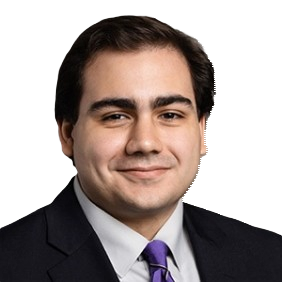
Senior Associate
Norton Rose Fulbright US LLP
Sebastian Souchet focuses his practice on representing US and non-US banks, broker-dealers and “buy-side” market participants on bank regulatory matters and regulatory, transactional and compliance issues related to securities and derivatives.
More specifically, Sebastian has experience advising US and non-US banks, bank holding companies, and other financial market participants on various bank regulatory issues including capital requirements, licensing/chartering requirements, control issues, affiliate and insider transactions, and the Volcker Rule.
Sebastian also has experience representing US and non-US banks and broker-dealers on various requirements arising under the US securities laws and the Commodity Exchange Act, including requirements relating to trading, supervision, recordkeeping, reporting, capital, margin and communications/marketing, as well as SEC and CFTC regulatory requirements arising under Title VII of the Dodd-Frank Act.
Sebastian also advises clients on complex financial transactions and has experience drafting and negotiating securities and derivatives trading documentation, including prime brokerage agreements, ISDA Master Agreements and various other industry-standard and bespoke trading and financing contracts.
Recent Articles & Comments
Given in the Federal Reserve’s supervision of Silicon Valley Bank, the proposed legislation from Senator Warren and Senator Scott is unsurprising. However, the establishment of an independent IG for the Federal Reserve may not necessarily lead to significant enhancements in public accountability. For example, the proposed legislation does not appear to include any specific mechanism for the publication of findings of an independent IG investigation. An independent IG is also not a…
While not specifically mentioned in the CRS report, it is notable that for purposes of certain provisions of the FDIA, the FDIC does not have the same rights in its capacity as administrator of a bridge bank that it does when it acts in a receivership capacity.
A bridge bank, for purposes of a number of provisions under the FDIA, is effectively not considered a failed bank subject to receivership. Thus, neither the FDIC’s general receivership powers, nor the 90-day stay that applies…
Governor Brainard's comments on stablecoin market concentration are important. Ms. Brainard notes that there "is a high degree of concentration among a few dollar-pegged stablecoins: as of January 2022, the largest stablecoin by market capitalization made up almost half of the market, and the four largest stablecoins together made up almost 90 percent" (pp. 1-2). Moreover, she highlights the fact that stablecoins are being used as a means of access to decentralized financial markets and…
The CRS report raises a number of important policy questions in addition to the question of which entities should be considered and regulated as banks.
Such questions include:
What, if any, anti-competitive effects does consolidation of the banking system have?
What are the implications of the consolidation of the banking system with respect to systemic financial risk?
What is the threshold for considering an entity a bank, and what, if any, impact does the…